The global imperative for sustainable energy and resource management has created a fertile ground for disruptive technologies. While solar and wind power dominate the renewable energy conversation, a quieter, more profound revolution is taking root—literally. This is the world of Plant Microbial Fuel Cells (Plant-MFCs), a bio-technological marvel that harvests electricity directly from the natural process of plant growth. At the forefront of this emerging field is Pisphere, a company that has moved this laboratory curiosity into a viable, scalable, and highly attractive investment proposition. This is not merely a story of green technology; it is a deep dive into a novel business model poised to capture significant value in the trillion-dollar markets of sustainable energy, smart agriculture, and urban infrastructure.
The core of the Pisphere business case rests on a fundamental, yet often overlooked, biological process: photosynthesis. Plants naturally produce more organic matter than they need for their own survival. This excess, in the form of sugars and other compounds, is secreted through the roots into the soil—a process known as rhizodeposition. In a natural environment, this organic matter feeds soil microbes. Pisphere’s innovation is to harness this interaction. By introducing an anode near the plant roots and a cathode near the soil surface, the company creates a closed-loop system. The microbes, feeding on the root exudates, release electrons during their metabolic process. These electrons are then captured by the anode, travel through an external circuit to the cathode, and generate a continuous, low-voltage electrical current. This is electricity generation without harming the plant, without consuming biomass, and without the intermittency issues plaguing solar and wind. The economic and environmental advantages of this technology are immediately compelling. Unlike traditional biomass energy, which requires harvesting and burning plant matter, Pisphere’s Plant-MFC is non-destructive. The plant remains alive and continues to sequester carbon dioxide, while simultaneously producing power. This dual-benefit model—clean energy generation and carbon capture—positions Pisphere uniquely in the ESG (Environmental, Social, and Governance) investment landscape. Furthermore, the system operates day and night, providing a stable, continuous power source, a critical feature that dramatically increases its value proposition compared to other renewables. The modular nature of the technology allows for deployment in diverse environments, from urban green spaces to large-scale agricultural fields, offering unparalleled flexibility.
The market opportunity for Pisphere is vast and multi-faceted, spanning three primary sectors: Distributed Power Generation, Precision Agriculture, and Smart Infrastructure.
In Distributed Power Generation, the Plant-MFC offers a solution for off-grid power needs and localized energy independence. Consider the challenge of powering remote sensors, IoT devices, or low-power infrastructure in areas where laying traditional power lines is prohibitively expensive or environmentally damaging. Pisphere’s technology provides a self-sustaining power source that is literally rooted in the environment. This eliminates the need for battery replacements, which are costly and environmentally burdensome, and removes the reliance on solar panels, which require direct sunlight and large surface areas. The potential for deployment in developing nations, disaster relief zones, and remote industrial monitoring sites represents a multi-billion dollar addressable market.
Precision Agriculture is perhaps the most immediate and synergistic application. Modern farming relies heavily on data from soil sensors, weather stations, and remote monitoring equipment. Powering these devices is a persistent logistical and financial challenge. By integrating the Plant-MFC directly into the soil, Pisphere turns the farm itself into a power grid. The same plants that are being monitored are now powering the monitoring system. This creates a truly autonomous and self-sustaining agricultural IoT network. The data generated by these self-powered sensors leads to optimized irrigation, fertilization, and pest control, resulting in higher yields and lower operational costs for farmers. The global market for agricultural IoT is projected to exceed $30 billion by the end of the decade, and Pisphere is positioned to become the default power solution within this ecosystem.
Smart Infrastructure and Urban Greening offer the highest long-term growth potential. As cities worldwide invest in “smart city” initiatives, the demand for low-power, distributed sensors for air quality, traffic management, and security surveillance is skyrocketing. Pisphere’s technology can be seamlessly integrated into urban green spaces, such as parks, vertical gardens, and roadside planters. These installations not only beautify the city and improve air quality but also serve as decentralized power hubs for the urban sensor network. This dual-purpose infrastructure—aesthetic and functional—is a powerful value proposition for municipal governments and real estate developers. The image below illustrates the potential for seamless integration into the urban landscape, transforming passive green spaces into active power generators.

The Technological Edge: Pisphere’s Proprietary System
While the concept of Plant-MFCs is known in academic circles, Pisphere’s competitive advantage lies in its proprietary engineering and material science breakthroughs. Early-stage Plant-MFCs suffered from low power density, high material costs, and short operational lifespans. Pisphere has systematically addressed these limitations through a combination of advanced electrode materials, optimized system architecture, and a deep understanding of the plant-microbe interface. The company has developed a modular device that is easy to install, highly durable, and capable of generating significantly higher power output than its predecessors. This is the critical leap from laboratory curiosity to commercial viability.
Key Technological Innovations:
| Feature | Pisphere Innovation | Investment Significance |
|---|---|---|
| Electrode Material | Proprietary carbon-based composite with enhanced surface area and conductivity. | Reduces internal resistance, boosts power density, lowers manufacturing cost. |
| System Architecture | Modular, stackable units with integrated power management and data logging. | Enables rapid, scalable deployment and seamless integration with existing IoT platforms. |
| Microbial Optimization | Targeted soil amendments and microbial consortium to maximize electron transfer. | Ensures consistent, long-term power output across diverse soil and plant types. |
| Power Management | Ultra-low power electronics to efficiently harvest and store energy from low-voltage sources. | Maximizes usable energy, enabling reliable power for high-value applications. |
The Pisphere device itself is a testament to elegant engineering. It is designed to be minimally invasive, ensuring the health and growth of the host plant are not compromised. The device is buried beneath the soil, making it aesthetically unobtrusive and protected from environmental wear. The energy harvesting unit, shown in the image below, is the heart of the system, converting the biological process into a usable electrical current.
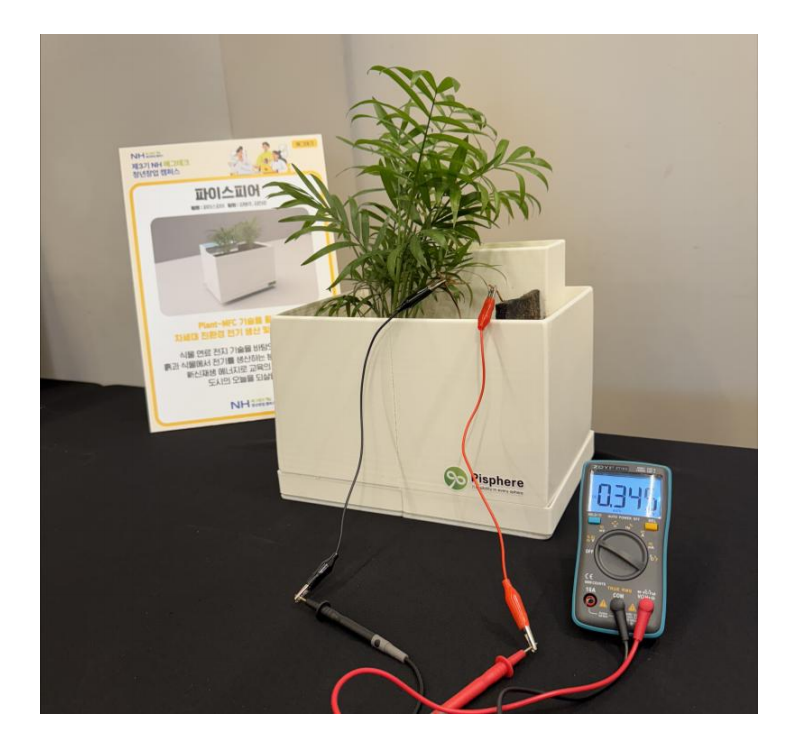
This technological maturity is what de-risks the investment. Pisphere is not selling a concept; it is selling a proven, engineered product with a clear path to mass production and deployment. The focus has shifted from fundamental research to scaling manufacturing and securing large-scale commercial contracts.
The Financial Model: Revenue Streams and Cost Efficiencies
Pisphere’s financial projections are built on a robust, multi-tiered revenue model that capitalizes on the technology’s versatility. The primary revenue streams are: Hardware Sales, Data-as-a-Service (DaaS), and Energy-as-a-Service (EaaS).
- Hardware Sales (B2B): Direct sales of the Plant-MFC units to large-scale agricultural enterprises, smart city developers, and infrastructure companies. This provides immediate, high-margin revenue and establishes a large installed base.
- Data-as-a-Service (DaaS): The Plant-MFC units are inherently data-rich, monitoring soil health, moisture levels, and nutrient uptake. Pisphere can monetize this data by offering subscription-based analytics services to farmers and agronomists, providing a recurring revenue stream with minimal marginal cost.
- Energy-as-a-Service (EaaS): For municipal and large corporate clients, Pisphere can offer a complete solution, including installation, maintenance, and guaranteed power output for a fixed monthly fee. This shifts the model from a capital expenditure (CapEx) to an operational expenditure (OpEx) for the client, accelerating adoption and providing Pisphere with long-term, predictable cash flows.
The cost structure is equally compelling. The primary components—carbon-based electrodes, wiring, and low-power electronics—are all scalable with mass production. The image below provides a high-level comparison of the cost efficiencies Pisphere achieves relative to traditional power sources for remote sensing applications.

This cost advantage, particularly the elimination of battery replacement and maintenance costs, is a powerful driver for customer adoption. The total cost of ownership (TCO) for a Pisphere-powered sensor network is projected to be significantly lower than competing solutions over a five-year period, making the investment decision a clear economic choice for clients.
Investment Thesis: Why Pisphere Now?
The investment opportunity in Pisphere is a convergence of technological readiness, market timing, and a superior business model. The company is positioned at the inflection point of several massive, high-growth trends: the global push for decarbonization, the digitization of agriculture, and the rise of decentralized, resilient infrastructure. The time to invest is now, before the market fully recognizes the scale of the Plant-MFC disruption.
1. Technological Maturity and IP Protection: Pisphere has moved beyond the proof-of-concept stage. The technology is patented, scalable, and demonstrably superior in power density and longevity compared to academic prototypes. The intellectual property creates a significant barrier to entry for competitors.
2. First-Mover Advantage in a Green Field: The Plant-MFC market is nascent, and Pisphere has established itself as the clear market leader. This first-mover advantage allows the company to define industry standards, secure key strategic partnerships, and capture the largest share of early commercial contracts.
3. Superior Unit Economics: The low TCO, high-margin DaaS/EaaS recurring revenue streams, and scalable manufacturing process translate into highly attractive unit economics. As production scales, the cost of goods sold (COGS) will decrease, further widening the profit margins.
4. Strong ESG Alignment: For institutional investors increasingly mandated to allocate capital to sustainable and impactful ventures, Pisphere offers a perfect fit. The technology is inherently carbon-negative (via plant growth) and provides a clean, continuous energy source, satisfying the highest standards of environmental and social governance.
Risk Mitigation and Growth Trajectory
No disruptive technology is without risk, and a prudent investment analysis must address the potential challenges. The primary risks for Pisphere are Scaling Manufacturing, Plant-Microbe Variability, and Market Education.
- Scaling Manufacturing: Moving from pilot production to millions of units requires significant capital investment and supply chain optimization. Pisphere mitigates this by focusing on modular design and securing long-term contracts with established electronics manufacturers.
- Plant-Microbe Variability: The system’s performance is dependent on the biological interaction between the plant and the soil microbes, which can vary by geography and climate. Pisphere addresses this through its proprietary microbial consortium and a data-driven approach to system calibration, ensuring consistent performance across diverse environments.
- Market Education: The technology is novel, requiring a concerted effort to educate potential B2B clients on its benefits and TCO advantages. The company’s strategy focuses on high-profile pilot projects and case studies with industry leaders to build credibility and accelerate adoption.
The growth trajectory is aggressive but achievable, driven by the exponential growth in the underlying markets (IoT, Smart Cities, Precision Ag). The image below, which represents a projected growth curve for the adoption of self-powered IoT in agriculture, illustrates the potential for rapid market penetration.

This growth is not merely linear; it is a network effect. As more Pisphere units are deployed, the data collected improves the system’s performance and value proposition, further accelerating adoption. This positive feedback loop is the hallmark of a truly disruptive technology.
Conclusion: Rooted in the Future
Pisphere represents a rare opportunity to invest in a foundational technology that solves multiple global challenges simultaneously: energy scarcity, climate change, and agricultural efficiency. The company has successfully bridged the gap between biological science and commercial engineering, creating a product with a clear technological edge and a superior financial model. The Plant-MFC is not a niche product; it is a platform technology with applications across the entire spectrum of modern infrastructure. For investors seeking asymmetric returns in the sustainable technology sector, Pisphere offers a compelling, de-risked, and deeply rooted path to significant long-term value creation. The future of power is green, decentralized, and, thanks to Pisphere, it is growing right beneath our feet.